Most tradespeople we talk to have been quoted wildly different prices for what sounds like the same thing. One person says a few hundred pounds, another says several thousand, and a website builder advert says twenty pounds a month. All three can be honest. They are just selling very different products.
This guide sets out the typical price ranges you will come across in the UK, what you get at each level, and how to work out what your business actually needs. These are ranges we see in the market, not fixed prices, and anyone can charge more or less.
The typical price ranges you will see
Roughly speaking, trades websites fall into four bands:
- DIY website builders: usually around £20 to £40 a month, and you build it yourself.
- One-page starter sites: often somewhere between £500 and £1,000, built for you.
- Freelancers: commonly £600 to £1,500 for a small multi-page site.
- Specialist trade web designers: typically £1,800 to £4,000 for a full site planned around your services and areas.
Hosting, domain and maintenance usually sit on top of the build price, either monthly or yearly. Always ask what is included, because two quotes that look far apart can end up close once you add the extras.
DIY builders: cheap each month, costly in time
A drag and drop builder is the cheapest way to get something online. For a sole trader just starting out, it can be a sensible first step.
The real cost is your time and the things you do not know to do. Most DIY sites we are asked to rescue have the same problems: the phone number is buried, the pages are slow on a phone, one page tries to cover every service, and Google has little idea which towns the business covers. Evenings spent fighting a template are evenings not spent quoting or with your family.
Over three or four years the monthly fees also add up to more than many people expect, and you rarely own anything you can move elsewhere.
One-page starter sites
A single page site built by someone else is a step up. Done well, it gives a customer everything they need in one scroll: what you do, where you work, a few real job photos, reviews and a way to get in touch.
It suits a new business, or one that gets most of its work from recommendations and just needs somewhere credible to send people. The limit is search. One page cannot rank for boiler repair in one town and bathroom fitting in the next, so it will rarely bring in new customers on its own.
Freelancers and specialist trade designers
A freelancer in the £600 to £1,500 range can build a perfectly good small site. The quality varies a lot, so look at sites they have built for other trades and try them on your own phone.
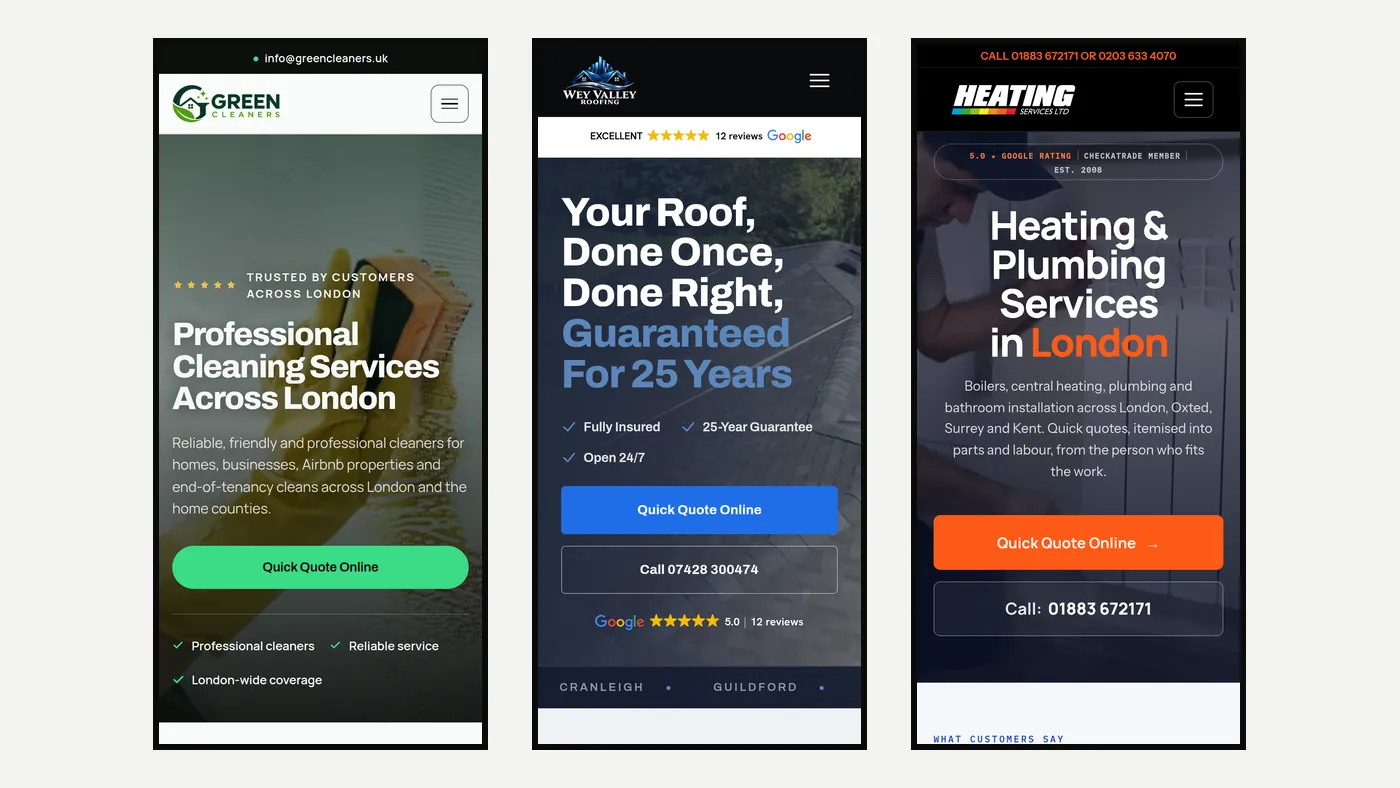
Specialist trade designers charge more because the thinking is already done. They know a homeowner with a leak decides in seconds, that most visits come from a phone, and that the first screen has to answer four questions: what you do, where you cover, can I trust you and how do I contact you right now. They build pages for each service and area you want more of, and set up the basics that help you show up in local search.
The extra spend is worth it if you want the site to bring in new work, not just sit there as a digital business card.
What you should get, whatever you pay
Whatever your budget, a trades website should do these things. If a quote does not cover them, ask why.
- A click-to-call phone number at the top of every page on a phone.
- Clear wording on the services you offer and the towns you cover.
- Real photos of your work, your van and ideally you, not stock images.
- Reviews or accreditations a customer can check.
- A short enquiry form, such as a Quick Quote button, for people who would rather not ring.
- Pages that load quickly on a phone signal, not just on office wifi.
- A domain name registered in your name, so you own it.
The costs people forget to ask about
The build price is only part of the picture. Before you sign anything, ask:
- What does hosting cost each year, and what happens if I stop paying?
- Who makes changes when I add a service or change my number, and what does that cost?
- Is the copy written for me, or do I have to write every page myself?
- Are my Google Business Profile and basic local search set up, or is that extra?
- Can I take the site and the domain with me if I leave?
Clear answers to these tell you more about a supplier than the headline price does.
How to decide what to spend
Start with what you want the site to do. If the diary is full from recommendations and you just need to look credible when people check you out, a good starter site is plenty. If you want to cut back on paid lead sites, win more of a certain type of job or grow into new towns, you need a site with room for proper service and area pages.
A useful test is to work out what one good job is worth to you. For many plumbers, electricians and heating engineers, a couple of extra jobs a month would cover the cost of a well built site well within the first year. Measured that way, the cheapest option is not always the one that costs least.
If you would like a straight answer on what your business needs, use the Quick Quote button and tell us your trade and the area you cover.